
How Do I Show Those Who Refuse To Hear King James Only Arguments?
From "Answers To Your Bible Version Questions" © 2001 by David W. Daniels
Question: How do I show which Bible is correct to those who refuse to hear “King James only” arguments?
Answer: The key is to show them how the broad evidence of history tells us which Greek text is correct. It then becomes easy to know which Bible we can trust. First, please remember the simple fact that there are two streams of Bible history. The first line comes straight from the Apostles and people of Antioch. To date, 5,702 manuscripts, and the broad evidence of history support that line.
The Broad Evidence of History
This evidence for this stream spans from some of our oldest manuscripts to some of the least ancient. These manuscripts are in agreement with those of the persecuted believers, such as the Vaudois in the Alps northwest of Italy. They received the Scriptures from apostolic groups from Antioch of Syria about AD 120 and finished their translation by AD 157, according to Calvin’s successor, Theodore Beza. These manuscripts influenced one of the greatest events in Christian history: the Protestant Reformation.
The Polluted Stream
The other stream comes from questionable sources. About the time of Christ, a Jewish man named Philo decided to blend pagan Greek philosophy with Judaism. The so-called “Christians” who came after him in Alexandria were not much better. Though they talked about “Jesus” and “Christianity,” they did not believe that Jesus was God. They also did not believe that the Old Testament detailed literal events. It was a school in this pagan city that decided to write their own copies of the Bible.
The problem is that they changed the Scriptures, while saying they were copying them. They used the heretic Marcion’s Lord’s Prayer in Luke, for example. (See Question 43, “Is the Lord’s Prayer in Your Bible?”). From there it goes downhill.
In truth there are only a handful of semi-complete “Bibles” from Alexandria, Egypt. The only other texts from there are literally pieces of paper. The grand total of manuscripts is only 44. Of those 44, only 3 are taken very seriously: the Sinaiticus (Aleph), the Alexandrinus (A) and Vaticanus (B).
But there is a very big problem. It is rare that these three ever agree. Between Sinaiticus and Vaticanus, for example, it is extremely difficult to find just two successive verses that agree.
Look at the Lord’s Prayer in Luke again. Between codices Aleph, A [Alexandrinus], B [Vaticanus], C [Ephraemi Rescriptus] and D [Bezae Cantabrigiensis] there is no agreement in 32 out of 45 words. That means these major books only agree in 13 out of 45 words!
A Visual Image
Here’s one way to explain the difference between the manuscripts. Imagine a stadium with 5,746 people. 5,702 of them are in harmony, agreeing with one another and enjoying themselves. But there are also 44 other people. These are not like the first. They dislike the crowd around them and slander their words when they can. But they have another problem: they also disagree with each other.
Which group would you rather listen to? The one with people in one accord, or the one that is filled with discord? The one that knows what it is saying, or the one that cannot agree on what it wants to say? The answer is obvious.
Where Do the Two Streams Lead?
A tree is known by its fruit. Where, then, do these two streams of Bibles lead?
The Alexandrian manuscripts fell into disuse, and many were relegated to a desert trashcan. A number of “scholars” tried to make the expensive codices better by changing the words to be more like the other stream, but they finally gave up. Those are the many corrections we see in the Sinaiticus and Vaticanus.
But where do the Alexandrian manuscripts lead? Straight to the Roman Catholic institution. They were used by Constantine with the help of Eusebius. They became the basis of the Apocrypha and many incorrect readings in the Roman Catholic Bible. They were used to dominate and subject true believers under a false religion. This was the Bible of the persecutors.
Alexandrian Bibles are legion. Such are the NIV, TNIV, NAS, CSB, ASV, ERV, TEV, GNB, Living, NCV, ISV, RSV, NRSV, etc., but also Catholic Bibles as the New American Bible, the Jerusalem and New Jerusalem Bibles. The Antiochian manuscripts (from which we got the King James Bible) continued to be used and were passed down by faithful Christians from generation to generation. The Vaudois, for example, passed them down faithfully by even having their children memorize whole books of the Bible. These faithful people hand-copied little Bibles they could fit in their heavy garments. They were ready to give an answer, literally “in season and out of season”!
And where do the Antiochian manuscripts lead? Straight to the Protestant Reformation. Wesley and writers of the Geneva Bible actually saw the Vaudois as a “pre- Reformation” group, even as the “two witnesses” who were protected by God in Revelation. (See pp. 115-116). That is how much they were indebted to these faithful.
Antiochian Bibles are easily recognizable. They are the Bibles of the Reformation: the Reina-Valera (Spanish), Diodati (Italian), Statenvertaling (Dutch), and all the other Protestant Bibles published between the 1530s and 1600s. In English they are the Tyndale, Coverdale, Matthew’s, Great Bible, Bishops Bible, Geneva and King James.
The fruit, for example, of the King James Bible in English is easily discernible. Look at many English-speaking Protestant denominations that were formed in an effort to get “back to the Bible.” The King James Bible was the starting point. The pilgrim Puritans in the USA switched from the Geneva to the King James in their next generation, despite the fact that they had used the Geneva since the 1560s. And ironically, the churches and Christians called “extreme Fundamentalists” and “rightwing extremists” are simply the churches that did not leave the fundamentals.
There are two kinds of churches: those that left their founding doctrines and those that stuck to them. There are also two kinds of Bibles: those that follow corrupt and perverted Alexandrian texts and/or Roman Catholic doctrine, and those that follow the line of preservation through godly and persecuted Christian brethren. The choice is obvious.
- See more articles on related topics:
- Bible Versions
- Changes in Bible Versions
- Two Types of Bible Versions
- History of Preservation
Products of interest:
-
51 Reasons Why The King James
224 pages
Here are 51 reasons to trust that God kept His promise to preserve His own words. -
Answers to Your Bible Version Questions
224 pages
David W. Daniels answers difficult questions about the KJV. Learn how to defend the KJV and why you can trust it. -
Look What's Missing!
256 pages
For years, publishers have been removing words, and even whole verses, from modern Bibles. What's missing from your Bible? Take a look! -
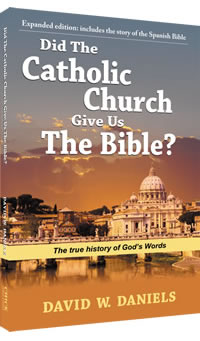
Did the Catholic Church Give Us the Bible?
208 pages
The Bible has two histories. One is of God preserving His words through His people. The other is of the devil using Roman Catholic "scholars" to pervert God’s words and give us corrupt modern Bibles. -
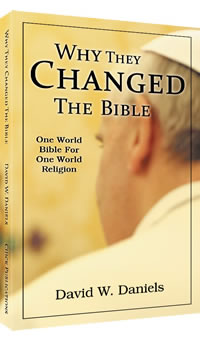
Why They Changed the Bible
228 pages
See who is behind the gradual changing of modern Bibles. There’s no guessing about what these people believe. They will tell you, in their own words!