
What's missing from the New American Bible or Douay?
From "Answers To Your Bible Version Questions" ©2001 David W. Daniels.
Reproduced by permission
Question: Is anything missing from the New American Bible or the Rheims-Douay?
Answer: Actually, there are many words both added to and missing from these Roman Catholic Bibles.
Adding to Scripture
The New American, Douay/Rheims and other Roman Catholic Bibles add to Scripture.
Old Testament Apocrypha
The Roman Catholic Old Testament adds uninspired books, which
we call Apocrypha, to the Bible, as if it were scripture.
- The additions to Esther
- Song of the Three Young Children
- Bel and the Dragon
- Judith
- Tobit
- Wisdom of Solomon
- Wisdom of Jesus ben Sirach
- I & II Maccabees
Roman Catholic Bibles, from the 300s AD to the present, include these uninspired Alexandrian Egyptian additions to Scripture. It wasn't until 1548 at the Roman Catholic Council of Trent that the Apocrypha was declared to be actual Scripture, in reaction to the Protestant Bibles. Translators of the King James Bible, God’s preserved words in English, were told to include the Apocrypha. But they wrote seven excellent reasons why not to include it in Scripture. Alexander McClure, in his book wrote down these reasons:
- Not one of them is in the Hebrew language, which was alone used by the inspired historians and poets of the Old Testament.
- Not one of the writers lays any claim to inspiration.
- These books were never acknowledged as sacred Scriptures by the Jewish Church, and therefore were never sanctioned by our Lord.
- They were not allowed a place among the sacred books, during the first four centuries of the Christian Church.
- They contain fabulous statements, and statements which contradict not only the canonical Scriptures, but themselves; as when, in the two Books of Maccabees, Antiochus Epiphanes is made to die three different deaths in as many different places.
- It inculcates doctrines at variance with the Bible, such as prayers for the dead and sinless perfection.
- It teaches immoral practices, such as lying, suicide, assassination and magical incantation.
So the translators were careful to separate the Apocrypha from the Bible, putting it in a separate section between the Old and New Testaments, with each page clearly labeled, “Apocrypha.” The last page of II Maccabees, in the 1611 King James reads, “End of Apocrypha.” Then it returns to God’s inspired words in Matthew.
Taking away from Scripture
New Testament -
But the Roman Catholic Bible is a perverted Alexandrian Egyptian Bible,
not a preserved Antiochian Bible, like the King James. It is a combination
of the heretical Egyptian Bible, including the Alexandrian Apocrypha,
and blended to look like the preserved Vaudois Latin scriptures.
It omits thousands of words and a number of entire verses.
The Roman Catholic New American Bible (also called the “St. Joseph’s Bible” is very similar, almost identical in New Testament text to many Protestant Bibles
- NIV (1973, 1978) and TNIV (the 2002 “Gender-Neutral” revision of the NIV)
- English Revised Version (1881,1885) and its USA revision, American Standard (1901)
- Revised Standard (1946, 1952) and NRSV (its 1989 “Gender-Neutral” revision of the RSV)
- Revisions of the American Standard, such as the New American Standard (1962) and the Living Bible (1971)
- Today's English Version
- New English and Revised English Bibles
- Moffatt, Goodspeed, Wuest, J.B. Phillips and many other Protestant Bibles.
What’s the Difference?
There is a lot added to (the Apocrypha) and taken away from (Alexandrian perversion) the Catholic Bibles. Most modern Protestant Bibles do not contain the Apocrypha, though some do. But there is almost no difference at all between the Roman Catholic New Testament and the modern Protestant perversions. Whichever you choose, ultimately you’re being led down the primrose path of perversion. The only way to completely avoid this “broad way” is to take the narrow path and read the King James Bible.
May God bless you as you read His preserved words in English, the King James Bible.
- See more articles on related topics:
- Bible Versions
- Catholicism
- Changes in Bible Versions
Products of interest:
-
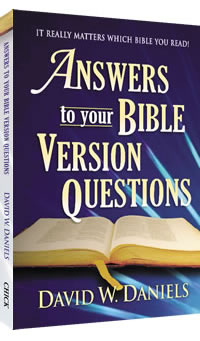
Answers to Your Bible Version Questions
224 pages
David W. Daniels answers difficult questions about the KJV. Learn how to defend the KJV and why you can trust it. -
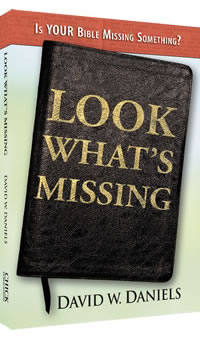
Look What's Missing!
256 pages
For years, publishers have been removing words, and even whole verses, from modern Bibles. What's missing from your Bible? Take a look! -
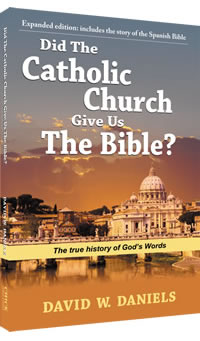
Did the Catholic Church Give Us the Bible?
208 pages
The Bible has two histories. One is of God preserving His words through His people. The other is of the devil using Roman Catholic "scholars" to pervert God’s words and give us corrupt modern Bibles. -
Is The "World's Oldest Bible" a Fake?
352 pages
Here is proof that the Sinaiticus, a supposedly ancient Bible text on which modern Bibles are based, is actually a 19th-century fake.