
Why the King James Bible would be good enough for Luke (or Paul).
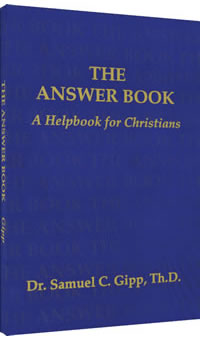
From "The Answer Book" ©1989 Samuel C. Gipp. Reproduced by permission
QUESTION: What does this statement mean? "The King James Bible was good enough for the Apostle Paul, so it's good enough for me."
ANSWER: This statement is usually made in a sarcastic manner in order to embarrass Bible believers in their belief. The FACT is, the King James Bible WAS good enough for Paul. (See Question #11) But for now I'd like you to see that it was the only Bible that Luke would use.
EXPLANATION: In Acts 1: 1,2 Luke makes the following statement: "The former treatise have I made, 0 Theophilus, of all that Jesus began both to do and teach, Until the day in which he was taken up, after that he through the Holy Ghost had given commandments unto the apostles whom he had chosen:"
"The former treatise" is of course the Gospel of Luke which Luke wrote to a believer named Theophilus. Theophilus was apparently an early Christian who had never personally met the Lord while He was on this earth. Considering, though, that he was the recipient of both the Gospel of Luke and the Acts of the Apostles, he was most certainly one of the best informed.
Luke, in what may have been a passing comment, in the second verse of Acts chapter one, rings the death blow to the famous Nestle's Greek New Testament and also the New American Standard Version. Luke states that his "former treatise" told of all that Jesus began to do, and continued, "until the day in which he was taken up." The things which Jesus began to do are first recorded in Luke 2:41-52 in which He was left behind in Jerusalem when Joseph and His mother left to return to Nazareth. This correlates with Acts 1:1. Luke's gospel is the only one of the four gospels which records any of Christ's actions prior to His baptism at the age of thirty years old. (Matthew 3:16, Mark 1:9 and John 1:29-34)
Luke's gospel ends with Christ being "carried up into heaven " in Luke 24:51. This correlates with Acts 1:2 "Until the day in which he was taken up."
Thus, Luke states that his gospel begins with the earliest acts of Christ and ends with His ascension. Therefore, any Greek manuscript or manuscripts, no matter what their age, containing the Gospel of Luke which omits either of these accounts is not authentic. In an examination of the 23rd Edition of Nestle's Greek Text we find that the Greek words, "Kai anepheroto eis ton huranon," "and was carried up into the heaven" are not found in this text.
The footnote in the critical apparatus indicates that the authority for removing this phrase is no more than manuscript (MS) Sinaiticus, D, one majuscule MS known as number 52 and one 5th century palimpsect (a MS which has been erased and written over top of). The phrase "and carried up into heaven" is found in B, C, E, F, G, H, L, S, T, V, Y, Z, Delta, Theta, Psi, and Omega plus papyrus p75, and most remaining witnesses. Yet on the basis of only two MSS the conservative scholars of the secret Lockman Foundation have omitted this phrase from Luke 24:51 in the New American Standard Version (NASV). Hence, the NASV is not truly a reliable translation. In fact, of most modern versions, only the "liberal" scholars of the Revised Standard Version (RSV) agreed with the "conservative" scholars of the NASV in omitting the phrase. Thus the known Communistic liberals of the RSV and the conservatives of the NASV are in full agreement that Christ did not ascend bodily into heaven.
So we see that if Luke, the writer of the Gospel of Luke and the book of the Acts of the Apostles, could examine a King James Bible and a New American Standard Version he would declare the New American Standard Version a fraud and promptly proclaim the King James Bible as authentic.
Well, quite frankly, if it's good enough for Luke, it's good enough for me.
- See more articles on related topics:
- Bible Versions
- King James Bible
- New American Standard Bible (NASB)
Products of interest:
-
Answer Book, The
165 pages
Over 60 of the most commonly asked questions about Bible versions are answered in an easily understood style. -
Understandable History of the Bible
557 pages
You'll learn the history of the Bible in this well-documented but easy-to-understand book. -
Answers to Your Bible Version Questions
224 pages
David W. Daniels answers difficult questions about the KJV. Learn how to defend the KJV and why you can trust it. -
Look What's Missing!
256 pages
For years, publishers have been removing words, and even whole verses, from modern Bibles. What's missing from your Bible? Take a look!