Customer Service


Issue Date: 9/23/2025

Is One Little Letter Such a Big Deal?

Hi friend,
Can a single Greek letter change the Gospel from being about God’s grace to being about man’s goodness?
Yes — and it already has in many modern Bibles.
Let’s take a look at Luke 2:14 and see how this tiny change turns the message of Christ’s birth upside down.
📖 What Did the Angels Really Say?
In the King James Bible (and Bibles from the Antiochian, or northern manuscript stream), Luke 2:14 reads:
“Glory to God in the highest, and on earth peace, good will toward men.”
The key word here is “eudokia” — a Greek word meaning "good will" in the nominative case. That means it is the subject of the sentence. In this verse, God’s good will is directed toward mankind.
This means peace is offered to all people, not just to some select group. It reflects verses like:
It aligns with the whole message of the Gospel: God’s offer of salvation is available to all, not just a worthy few.
✏️ A Tiny Change with Big Consequences
But in Bibles based on the Alexandrian manuscripts (the southern stream), one tiny letter is added to the word eudokia — a final sigma ("s" in English), turning it into eudokias.
That one letter changes the word’s case from nominative (the subject) to genitive (possessive).
Now the verse becomes something like:
“Peace among men of good will”
or
“Peace to those with whom he is pleased.”
Suddenly, peace is not for everyone. It’s only for those with good will or those with whom God is somehow already pleased — implying some kind of worthiness.
Different translations say it in slightly different ways:
But the message is the same: God’s peace isn’t for everyone, only for a certain group.
⚠️ Why It Matters
This single-letter change creates several serious theological problems:
This twist opens the door for a man-centered gospel — one that says some people are inherently “better” or more acceptable to God, rather than recognizing that all have sinned, and all need grace.
🧍 My Personal Testimony
Early in my Christian walk, this version of Luke 2:14 influenced how I understood sin. At Bible college, I was taught that:
This led me to retranslate parts of the book of Romans, changing key words like “righteousness” to “acquittal.” It sounded fair, even modern. But it wasn’t biblical.
I was making a man-centered Bible, not a God-centered one.
And it all started with one Greek letter.
🧪 Works vs. Grace: A Battle in One Verse
Romans 11:6 puts it clearly:
“And if by grace, then is it no more of works: otherwise grace is no more grace…”
But in Alexandrian-based Bibles, even this verse is altered. The second half is removed, erasing the warning that works cancel out grace.
These aren’t just academic differences. These are doctrinal attacks that slowly shift people’s thinking away from:
🧭 The Importance of the Right Bible
Once you start changing the text of Scripture — even one letter — where do you stop?
That’s why it’s so important to stick with the Bible God preserved — the King James Bible, based on the Antiochian (northern) manuscripts passed down by faithful believers, not altered by scholars in Alexandria or Rome.
💧Which Stream Are You Drinking From?
The two manuscript streams have two very different foundations:
Choose carefully. One letter may seem small, but it can completely change the message of the Gospel.
“Man shall not live by bread alone, but by every word of God.” (Luke 4:4)
Every word matters — even one letter.
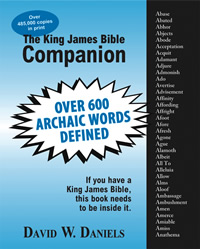
Because every word matters!
Definitions of over 600 less-familiar KJV words. Tuck it in your King James Bible as a handy reference tool.
"A must-have reference tool"
"This is a perfect refrence tool that I keep with my Bible at all times. If I run into an unfamiliar word, I bring this out and familiarize myself with the older English vocabulary. Everyone should have one of these."
— J.S. (Verified Buyer)
Missed the previous emails? Click below to browse them all.
Customer Service
Have a question? Please contact us.
By Phone: 1-909-987-0771
Email: postmaster@chick.com
Fax: 1-909-941-8128
Do you have testimony
you would like to share?
Just email it to testimonies@chick.com
Or share it on our social media pages below.
We would love to hear from you!
Do you live outside the USA? Find a distributor of Chick tracts in your country.
If you no longer want to receive these emails from us, please unsubscribe.