
Don’t Write Them Off

Young people may be more interested in the gospel than many Christians realize.
That is what Mark Vance, lead pastor of Cornerstone Church in Ames, Iowa, says his church is seeing. Cornerstone draws about 4,000 adults, and 18-to-25-year-olds have played an important part in its growth.
“We find that demographic, 18 to 25, is wildly open ... to Christianity and the gospel,” Vance said. “They’re curious, they’re asking questions.”
Cornerstone grew out of a campus ministry at Iowa State University. They are also part of the Salt Network, a group that has planted more than 40 churches in university cities across 28 states.
Faith Meets the Culture
Vance believes that some of the interest he is seeing comes from young people trying to find something dependable in a world of artificial intelligence, deepfakes, and misinformation. In short, “There’s a hunger for truth.”
According to recent research from Barna, that hunger for truth doesn’t stop once young people have begun taking Christianity seriously.
Barna recently surveyed 1,500 American teenagers and identified a group it calls “Faith-Activated” teens. These young people are highly engaged in their spiritual life including areas like evangelism, service, and integrating faith into everyday life.
Unsurprisingly, these engaged teens also reported experiencing a high degree of tension between their faith and the culture around them.
Forty-four percent said they feel tension between their faith and what friends or culture expect of them. Forty-three percent said they have difficulty connecting their beliefs about God to real-life situations. And fifty-one percent stated that their faith feels “more private than connected to everyday life.”
The research revealed another interesting tension. Sixty-four percent of Faith-Activated teens strongly agreed that there is a universal right and wrong that applies to everyone. At the same time, 58 percent of that same group strongly agreed that people should decide what right and wrong is for themselves.
Barna interpreted some of these tensions as evidence that young people who take their faith seriously are becoming more aware of the difficult questions around them.
“Faith-Activated teens aren’t wrestling with these questions because they’ve disengaged; they’re wrestling because they’re paying closer attention,” the researchers wrote.
An Open Door
Young people with little previous connection to church are curious about Christianity and are asking questions. Meanwhile, young people who are already serious about their faith are discovering just how different biblical Christianity can be from the culture around them.
That makes this a unique and important time. We don't have to assume that the young person we meet isn't interested in the gospel. As Vance is discovering in Iowa, some may be far more open than we expect: “They’re curious, they’re asking questions.”
The opportunity is there. We just need to take it.
One of the easiest ways to get the gospel to young people is to keep Chick tracts with you and offer them to those you meet. A tract doesn't require a long conversation or the perfect opening. It simply puts the gospel into someone's hands and gives them the opportunity to consider it for themselves.
We may never know which cashier, server, student, or young person we meet is already looking for answers. Let's make sure they have the chance to find them. That includes the most basic answer: the gospel (good news) that they can have their sins forgiven by their loving Creator. All other answers flow from that one.
- See more articles on related topics:
- Evangelism
- Other Subjects
Products of interest:
-
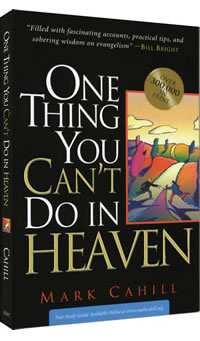
One Thing You Can't Do In Heaven
223 pages
What are you doing of significance today that will matter three-hundred-million years from now? You certainly cannot win a soul in heaven. Inspiration and ideas for witnessing. -

One Heartbeat Away
254 pages
You died. Now what? Is there anything out there after we take that last breath? -

This Was Your Life
Most Popular Chick Tract! Everything you've said or done will be played back at judgment. Are you in the Book of Life? -

Party Girl
A young woman's brush with death reveals Satan's plot for her destruction. -

Unloved
Rejected by his family, unemployed and with no one to turn to, Jimmy was ready for suicide. But then he met the One who truly loves him. -

Then What?
After Jesus comes to get His people (rapture)... Then what?