


Scientists Ask Forbidden Questions
On October 5, The Times reported something few expected: a French book arguing that modern science points decisively to God has become a runaway bestseller. God, the Science, the Evidence — by Michel-Yves Bolloré and Olivier Bonnassies — has already sold more than 400,000 copies in Europe and is now available in English.
The two authors argue that the latest scientific theories “lead to only one logical conclusion: an all-powerful deity created the universe and all life within it.” Their aim is to dismantle the materialist framework that claims nothing exists except the physical world, and everything is the result of chance and natural forces. They emphasize that this conclusion arises from the evidence emerging from physics, cosmology, and biology.
Even more shocking is who is standing with them. Leading astrophysicists, neuroscientists, and philosophers all vetted the book’s scientific claims. Nobel Prize–winning physicist Robert Wilson agreed to write the foreword. Though not persuaded toward belief, he wrote, “If the universe had a beginning, then we cannot avoid the question of creation.”
Wilson’s willingness to engage the discussion openly, rather than dismiss it, marks a notable break from decades of scientific consensus that has often treated such ideas as taboo. That alone signals a massive shift in the scientific community.
How Did Life Begin?
The authors also wade into the most protected territory in science: life’s origin.
The standard explanation says that life emerged from a primordial soup through chance. However, the authors aren’t buying it.
Bonnassies points to the staggering complexity of DNA. “DNA appeared on earth... and it was a technological marvel… 40,000 billion times more dense than the most advanced computer today.”
This one fact alone, the authors state, points to the “infinite improbability” of life evolving — that the chances are so small it is scientifically improbable to calculate. For the first time in decades, that observation isn’t immediately dismissed with a handwave and a look of annoyance. More scientists are beginning to admit that the improbabilities reveal a serious gap in the theory — a gap too large to paper over with slogans.
Scientists Are Reconsidering God
This new openness mirrors another trend: a rising number of scientists are abandoning strict materialism because it simply fails to answer life’s deepest questions.
Jana Harmon, author of Atheists Finding God, recently studied sixteen PhD-level scientists who moved from atheism toward belief. Presenting her findings at Reasons to Believe, she noted: “For a strong majority, the primary reason for change was intellectual… an inner drive for answers that made sense.”
Materialism is losing ground because the worldview can’t explain consciousness, morality, meaning, or even rational thought. As philosopher Edward Feser put it, materialism becomes “a snake that eats its own tail.” If the mind is just an illusion created by random brain chemistry, then materialism itself becomes untrustworthy.
A Door Opening Wider
A rare and exciting moment is unfolding: scientists are acknowledging that the old explanations don’t work — and that the concept of God cannot be dismissed as incoherent or unscientific.
The inability of evolution to explain life’s origin, the mysteries of consciousness, and the increasing number of scientists reconsidering the limits of materialism suggests a shift in intellectual openness rarely seen in modern science. These are indicators of a culture beginning to ask the questions it once forbade.

Donations to the mission fund are processed for us by PayPal. You can use a credit card or PayPal account.
Please use the "Donate now" button below to be redirected to PayPal to make your donation by credit card or your PayPal account. Thank you!
Other Articles from January/February 2026:
More on Evolution:
Products of Interest:

Big Daddy?
A student proves evolution is full of holes.
Trust the Science
Why do we believe in Jesus? It’s not just science. It’s the eyewitnesses!-

Stories from the Bible
176 pages
These beautiful illustrations help tell the true stories of some of the biggest Bible figures. You'll get a fresh mental picture of what it was like for these heroes of the Bible. -
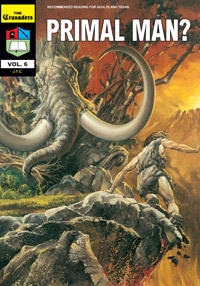
Primal Man?
32-PAGE, FULL COLOR COMIC BOOK - This story proves evolution is impossible. Connelly says he is convinced, but keeps producing evolution films. You will learn why.

Soul Survivor
Your soul is the real "you." Do you know where "you" are going?