


The Ripple Effect of One Tract
Late to a school assembly, 14-year-old Elizabeth walked through the gate just as an American missionary couple passed by. They handed her a small comic-style booklet—This Was Your Life!
She read it. And everything changed.
At the time, her home was steeped in spiritual darkness. Her father was deeply involved in occult practices, bringing voodoo objects into the house—items meant to protect the family, but which instead brought fear and chaos. Ritualistic objects were hidden under beds. Spiritual oppression was normal.
Even as a child, Elizabeth sensed something was wrong.
“My family thought something was wrong with me for not participating in these rituals which were meant for protection and prosperity. Because these rituals were thought to bring these “blessings,” they were particularly important to my parents. They were coming from protective instincts but were misguided.”
“I wanted to run away from home,” she later said. “But that tract brought hope into my life.”
She began attending meetings with Scripture Union, a Christian group focused on Bible study and discipleship. The leaders there quickly noticed something in her—a hunger, a fire, and a desire for truth.
But her new faith came at a cost.
Her mother forbade her from going and threatened to disown her. At one point, her mother destroyed her belongings, leaving her with nothing but her school uniform to wear. Her siblings were turned against her.
Still, she refused to turn back. “The Lord had already opened my heart,” she said. “Nothing would pull me away.”
In time, even her father noticed the change. While he remained involved in the occult, he stopped forcing her to participate in rituals.
As she grew, her faith deepened.
Elizabeth continued with Scripture Union, eventually marrying and carrying her passion for evangelism into adulthood. In Ghana, she began visiting the Challenge Bookshop, buying gospel tracts and taking to the streets to share them.
Later, after moving to San Francisco, she kept doing the same thing—handing out tracts to anyone who would listen and sharing the gospel one conversation at a time.
The message that reached her as a child became the message she carried to others.
For years, her family relationships remained strained. Her siblings, influenced by their upbringing, opposed her faith. But God was still at work.
Near the end of her life, Elizabeth’s mother gave her life to Christ. Later, one of Elizabeth’s sisters, dying of breast cancer at age 54, was overwhelmed with fear. But in her final days, she professed faith in Christ and even apologized for the years of rejection.
Years later, Elizabeth returned to Ghana with a mission. She exposed her American church to the Ghanian village where it all began. Together, they helped build a 600-seat church. Today, more than 1,000 people gather there.
But a new challenge has emerged.
The Ahmadiyya Muslim Community has made significant inroads in the region. With seemingly unlimited funding and infrastructure, they provide social services like education, healthcare, and basic food provisions. The Ahmadiyya clerics also provide midwifery services to the Fanti villages. These services in particular have been a big hit because the death rate for the mother and baby is incredibly high right after delivery. As a result, many choose to leave Christianity and “convert” to Islam because of the promised assistance.
“Islam is a force,” she said. “They have the money. They have the manpower.”
Yet she remains convinced that the answer is the same as it was when she was 14 years old: “Not by power, not by might, but by the Spirit of God.”
Now, she is coordinating with a local partner to translate This Was Your Life! into the Fanti dialect, a language widely spoken in parts of Ghana. A translator has already been identified, and the goal is to print and distribute thousands of copies across villages and communities.
It is, by every measure, a step of faith. Still, she is convinced of both the need and its potential impact. “This tract saved me,” she said. “It found me. And it can find others.”
In a region where large movements and well-funded initiatives often shape the landscape, her approach remains strikingly simple: one tract and one transformed life at a time.
After all, that is how her own story began as a teenager. In one unexpected moment, a small booklet was placed in her hands and the God who had been at work long before she knew it showed up and forever changed her life.
- See more articles on related topics:
- Evangelism
- Do Tracts Work?
- Tract Witnessing
Donations to the mission fund are processed for us by PayPal. You can use a credit card or PayPal account.
Please use the "Donate now" button below to be redirected to PayPal to make your donation by credit card or your PayPal account. Thank you!
Other Articles from July/August 2026:
More on Evangelism:
Products of Interest:
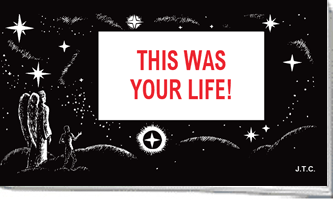
This Was Your Life
Most Popular Chick Tract! Everything you've said or done will be played back at judgment. Are you in the Book of Life?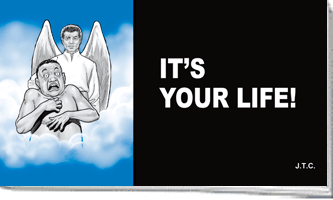
It's Your Life!
Special version with black characters. Everything you have said or done will be played back at judgment. Will your name be in the Book of Life?